
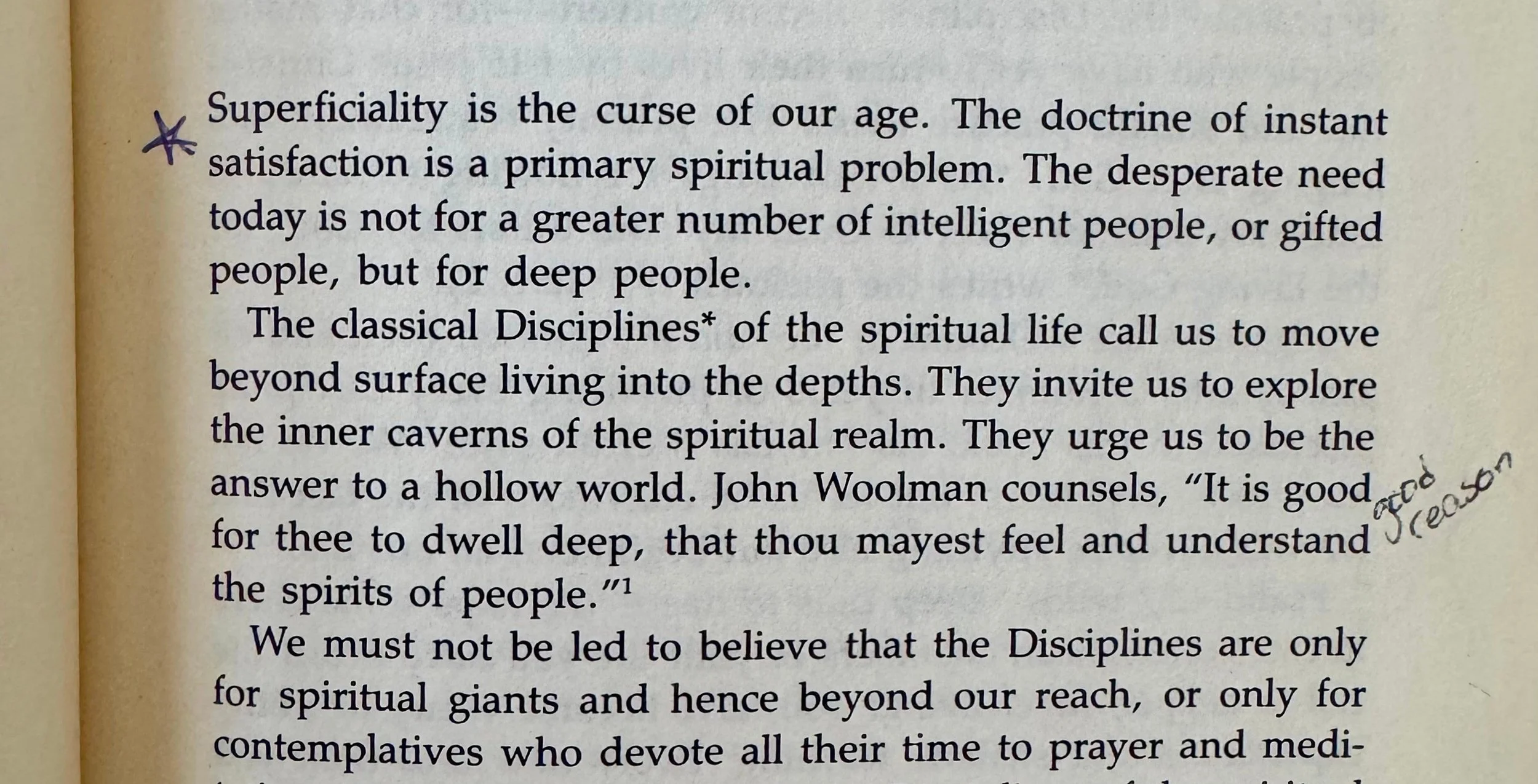
“Superficiality is the curse of our age. The doctrine of instant satisfaction is a primary spiritual problem. The desperate need today is not for a greater number of intelligent people, or gifted people, but for deep people.”
Richard Foster
Nearly 50 years ago, Richard Foster opened Celebration of Discipline with this line. It first captured my imagination as a teenager in the ‘90s, and I keep coming back to it now.
We are in a spiritual crisis. I am certainly not the first or only person to suggest this. In fact, a few hours after thinking about writing this, a friend shared an Instagram carousel about the current moment. One of the posts said this:
There is a social issue in this crisis, but there is also a spiritual issue. The two go hand in hand. Without the social dimension, we fall into fanaticism. Without the spiritual dimension, we fall into pessimism and meaninglessness.
And we’re not just facing a spiritual issue within the {buzzword incoming} polycrisis of this general moment, it is one reason we are here to begin with. We have detached ourselves from the spiritual—over-indexing on fundamentalist religious and political ideologies and generally splashing around in the shallow end of life.
What does it mean to be ‘deep people’?
In Celebration of Discipline terms, it is practicing the classic, or ancient, spiritual disciplines that pull us into the depths.
These include meditation, prayer, fasting, solitude, and service, among others. While Foster is speaking from a Christian framework, these spiritual disciplines are common across religions and cultures.
One could view religion and spirituality as a Venn Diagram, with spirituality exploring the nearly universal search for meaning, and religion as a set of beliefs, practices and language that characterizes a community searching for transcendent meaning in a particular way, generally based upon belief in a deity. These overlap, of course, but I’m sure that the specifics of that overlap are debatable.
But we are focusing on spirituality, which Christina Puchalski, MD, Director of the George Washington Institute for Spirituality and Health calls the “the aspect of humanity that refers to the way individuals seek and express meaning and purpose and the way they experience their connectedness to the moment, to self, to others, to nature, and to the significant or sacred.”
I think about Richard Foster writing about the curse of superficiality and instant gratification in 1978, and I think about 17-year-old Katie feeling the same way 30 years later. I look back at both eras and crave the simplicity.
I had no idea not even two decades later, we would be drinking from a fire hose of information and other people’s thoughts. Or that I would (literally a half hour before starting to write this) google “what makes doom scrolling addictive?” Or that we would be using the word google as a verb or the word doom scrolling at all. (Side note: I first wrote this in early 2025, and I’m too tired to update it with any talk of AI. I just can’t.)
Get me off this ride.
And it is the constant absorption of Happenings and each other’s thoughts and opinions on said Happenings paired with a lack of contemplation and silence that brings us to our current moment.
I don’t think superficiality and shallowness are about frivolity. I think we can be silly and fun and deep. These aren’t mutually exclusive. The superficiality that is the curse of our age is our embrace of constantnoise—and the consequences of that.
I’m so tired.
You already know I was seeking help for my doomscrolling addiction, so you’re aware that I have no answers for how to get off this ride. I just know that we have to.
And there is one thing I keep coming back to: grounding ourselves in what is good, true, and beautiful—and I truly believe that begins with silence.
“Let stillness be the criterion for assessing everything.” —Evagrius
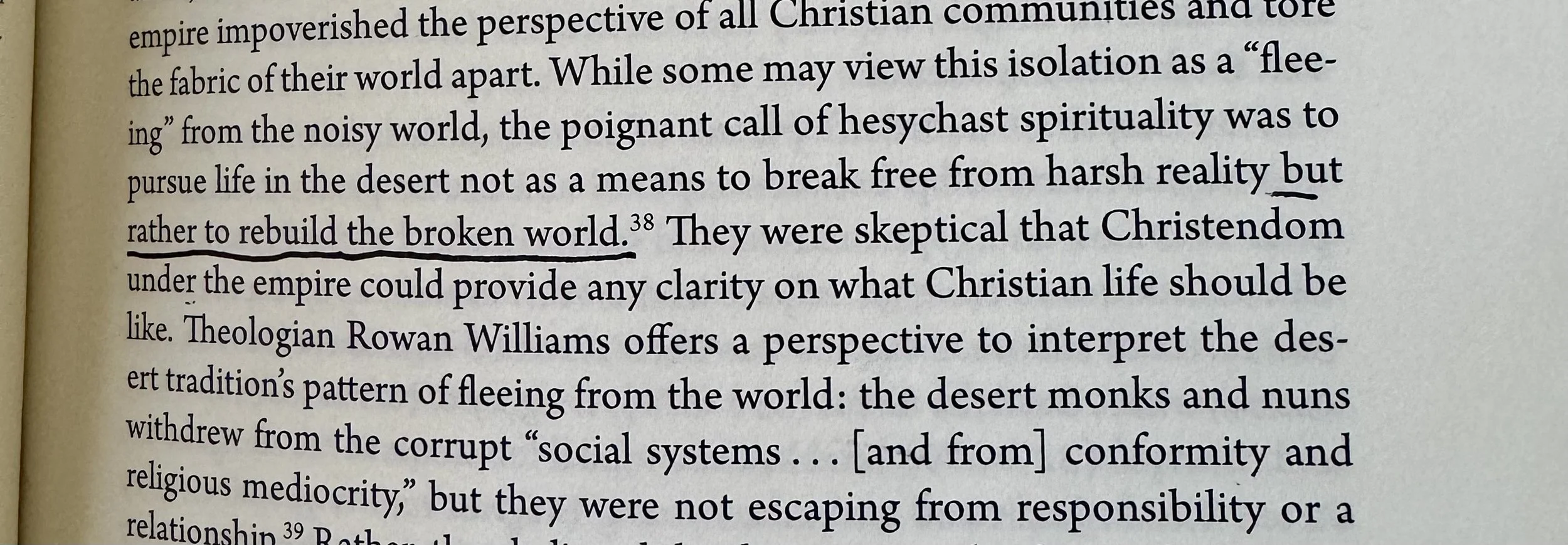
Min-Ah Cho writes about Evagrius and the other Desert Fathers and Mothers in her book The Silent God and the Silenced: Mysticism and Contemplation Amid Suffering.
She says, “Silence in liturgy can help us recognize the inexplicable component of life experiences before we react rashly or allow those experiences to be written over by ideologies of dominance and abrasive political agendas.”
Another world is possible. Maybe we can get there if we can quiet ourselves enough.