‘Inhabiting the Uninhabitable:’ The Need For a Theology of Trauma and Grief in Spiritual Care Settings

“There’s something revolutionary about creating a space for people to lay down what burdens them.”
–Prentis Hemphill, What it takes to heal
Originally attributed to psychologist and founder of Somatic Experiencing® Peter A. Levine, a simple definition of trauma has become commonplace in our lexicon: anything that is too much, too fast, and too soon. Taking this definition at face value, it can easily be asserted that most, if not all, people have experienced or will experience some kind of trauma in their lives. The National Center for PTSD backs up this anecdotal assertion. Often, trauma overlaps with grief, defined as deep and poignant distress caused by or as if by bereavement (Merriam-Webster). One can experience grief without trauma, but often grief is also present where there has been trauma. With both grief and trauma, loss is a common denominator.
Both Christian redemption narratives and professional and popular psychology have set out to address grief and trauma, and while intentions are undoubtedly good, they have often inflicted harm. This paper will address these issues and propose ways forward for a theological approach to trauma and grief through biblical lament and claiming sacred space and holy reimagination.
The problem with redemption narratives
Western Christianity has reinforced redemption narratives that have largely gone unchallenged and that have been harmful, particularly to the disabled and marginalized. “The language of resurrection is, in many cases, the language of the oppressor” (Rambo, 2010, p. 129). Sometimes redemption, in the classic definition of the term, is simply not achievable without reimagination. A few years ago, I was reflecting on this during National Infertility Awareness Week. The dominant narrative around infertility, which affects 1 in 6 couples, is that to have a happy ending, you must fix your life. You must have a baby, no matter what it takes. But in reality, 1 in 5 women are childless. It is fairly common for infertility journeys to end without a baby. And this is just one example of a situation or condition that, for many, cannot be fixed. Unfixable situations and conditions are part of the human condition. It’s universal. And it’s not even necessarily a worst-case scenario–sometimes it’s just another way to live (Koranda, 2023).

But the neat narrative of the death and resurrection of Jesus is a redemption narrative that suggests triumphant and tidy endings. It pushes and pulls toward fixing rather than being. And it has infiltrated more than Christianity, but American thought itself. This is a narrative that doesn’t acknowledge the Holy Saturdays—the day between Christ’s death and resurrection—we experience, or the death that remains even after life is found. Rambo (2010) asserts that a gospel with death at the center—or even a triumphant ending—is not good news at all but bad news for those who suffer.
And it’s not just harmful for those who suffer: atonement theories have toxic psychological and social effects. Rambo (2010) asks the question: What if we imagine beyond this? What if there are alternative notions of redemption? “What if the concept of flourishing is not an alternative to the concept of salvation but, instead, the vision forged in salvation’s collapse” (Rambo, 2010, p.169)? Further, as seen in the example above, the redemption narrative is harmful because it is simply not realistic. In trauma–and in grief–death (both literally and metaphorically) persists in life. A linear understanding of redemption and salvation does not allow for the “disruptive temporality” of trauma to be addressed (Rambo, 2010). “The undertow of a triumphant redemptive narrative is this: despite claims to victory and overcoming, there are fragments–unintegratable aspects of suffering that remain” (Rambo, 2010, p.159). The fragments that remain–that is what we need to attend to and the journey that we need to accompany people on as spiritual care providers.
The problem with linear healing narratives
In 1969, psychologist Elizabeth Kübler-Ross introduced the Five Stages of Grief: denial, anger, bargaining, depression, and acceptance (Lehne, R. A., & Rosenthal, L. D., 2023). In the decades that followed, this theory infiltrated American culture to such a degree that its original meaning was lost, and it became canon that people heal from grief in these five linear stages. This misunderstanding has led to frustration and harm for people who cannot seem to “do it right.” This theory has even been adopted by the change management field and applied to the Change Curve. Ironically, the field of change management uses this framework while largely ignoring the grief and loss inherent to change. But I digress. The stages of grief came from a study about how many people who are terminally ill move through stages after their diagnosis. It was never meant to be applied to grief writ large.
Lament as a theology of and practice for trauma
These two examples, redemption narratives and misapplied psychotherapy theories, point to a need for trauma-sensitive theology and grief literacy within spiritual care settings. There are many approaches and ways to pursue a theology of trauma for spiritual care practitioners, particularly spiritual directors. One such approach I have found useful is biblical lament. Lament is a liminal space where we don't have to say or even believe theologically accurate things. For example, if we believe that God doesn't cause pain, but in our grief we let ourselves give way to that feeling, it's okay. It's safe—even if we don't believe it outside of that liminal space of lament. Lament offers the freedom and the space to just be—to be still (Psalm 46:10, New International Version), or "let it be," as theologian Ellen Davis's translation says. “The sheer number of these laments forces us to take them seriously as a biblical model for prayer. They constitute the largest category of psalms in the Bible, outnumbering even the psalms of thanksgiving. Now this is a curious thing, because the Hebrew name for the Psalter is Tehillim, "Praises:' It is called the Book of Praises, yet it includes more laments than anything else” (Davis, 2001, p.15). Biblical laments generally follow a similar pattern:
Bringing your anger, pain, heartache, or sadness before God
Remembering God’s presence in your past
Petition/request
Rage against your enemies
Assurance of being heard
Promise to offer praise to God
Sometimes we move from sorrow to joy in a linear fashion, but so often we are left holding this closed loop where sorrow, joy, and anger find ways to co-exist. That is the comfort that can be found in the Psalms. And it is the theology of remaining that Rambo (2010) espouses. But sometimes, the laments don’t follow their own formula. Psalm 88 ends with the line, “darkness is my closest friend” (Psalm 88:18, New International Version). I am struck by how this Psalm doesn’t follow the "pattern" of other laments. It stays in the dark. It stays in the Holy Saturday. If one were to look at the Psalms of lament as formulaic, they might deduce that there is a formula to grief. But as we read earlier, this is not the case. If the structure found in lament were taken literally, one might be tempted to have a new lament: “Why can’t I just move on to the part of the formula where I can see how God moved in the past and praise God for some kind of answer or deliverance?” But as in all things relative to the Bible, the formula presented in the structure of lament is not to be taken literally.
Lament is uncomfortable. Grief and trauma—in all their sacred liminality—are uncomfortable. And sometimes, like in Psalm 88, they don’t resolve nicely. In many ways, this is the space people who have experienced trauma occupy. Smack in the middle of a lament. “Lamentation…moves us through anger and sadness, empowering us to truly hear and respond to the always-tragic now” (Rohr, 2025). Engaging in lament allows us to experience the full range of human experience and emotion while drawing closer to God in the midst of life’s Holy Saturdays. We can let go of expectations, advice, and opinions. We can let go of triumph. In doing so, we can find belonging, comfort, peace, and maybe even a little meaning–much like in spiritual direction itself.
Spiritual directors seek to provide and foster a sacred space, listen without judgment, and use a spiritual lens as it relates to directees’ spiritual practice. Spiritual direction is different from therapy or life coaching; there are no treatment plans or goals. The spiritual directors’ scope–and perhaps challenge–is to become trauma-informed and grief-literate, while not engaging in psychotherapy modalities (Juniper House, 2025). I use the word challenge because we are companioning whole people. Spirituality is not neatly separated from mental, emotional, or physical health. While some modalities are clearly to be used by trained psychotherapists, for example, EMDR, other modalities, such as dreamwork, narrative therapy, and art therapy, present more nuance.
Reclaiming holy imagination
Hansen (2024) references Herman’s (1992) three-stage treatment model as a way, if not the way, spiritual care providers can work with people who have experienced trauma. “While spiritual care providers are not trained to help individuals process traumas at a psychotherapeutic level, they can nonetheless engage in these three targeted interventions that may help resolve spiritual struggles that trauma initiates or exacerbates” (Hansen, 2024, p.23). They are as follows:
Rediscover a sense of safety
Process trauma emotionally through meaning-making activities like remembrance and mourning
Engage in acts that allow them to reconnect with their community as someone who has integrated trauma into their lives
Ultimately, the scope of practice comes down to practicing discernment: to knowing what is ours to engage with as spiritual directors and having a mindset of accompaniment paired with a lens of spirituality.

Spiritual directors can aid in these three interventions through accompaniment. The witness that takes place in this accompaniment requires a “capacity to imagine beyond an ending, to imagine life where it is not, in face of the impossibility of a future” (Rambo, 2010, p.168). This reimagining is not a poetic luxury, but a necessary component of healing (Rambo, 2010, p.123). Hemphill (2024, p.18) says that healing begins in the realm of dreams and imagination. Trauma, they say, takes the capacity for vision from us. “The future is hazy when we can’t perceive too far ahead, it’s impossible to imagine that we can shape what comes and create a future we’ve never seen.”
There are many ways spiritual care providers can help shepherd this reimagination through spiritual and contemplative practices. Engaging in these practices with directees is a gentle way to foster meaning-making in ways that don’t force meaning-making. The practices in Figure 1 are an example of practices that facilitate healing through providing a sacred space for directees to attune to and connect with their inner voice and to the stirrings of the divine. They can practice agency, stillness, creativity, and discernment.

Figure 1. Spiritual Practices (Juniper House, 2025)
We can also accompany people in attuning to their own longings, which Hemphill (2024) asserts vision and imagination are rooted in. Hemphill (2024, p.20) offers up some evocative questions in this pursuit:
To what and whom are you committed?
What do you long for?
What is worth traveling through the unknown to reach?
Reclaiming sacred space
Finally, in order to do all of this, spiritual care providers need to claim space for people who have experienced loss.Grief–and trauma–demand it. Spaces and ceremonies abound for what I call “tangible” loss. There are funerals, cemeteries, and memorials. And that matters because these spaces help us find meaning in our loss. To heal, we need to inhabit the uninhabitable (Bonder, 2009). This type of space can be hard to find for those experiencing the trauma of disenfranchised grief and ambiguous loss, such as infertility, divorce, chronic pain, religious trauma, and so much more. It can also be fleeting for those who have experienced death loss.
It’s worth pausing here to consider some definitions of healing. One definition that has helped shape my practice is from the Samueli Institute: “Healing is a holistic, transformative process of repair and recovery in mind, body, and spirit resulting in positive change, finding meaning, and movement towards self-realization of wholeness, regardless of the presence or absence of disease” (duBose, MacAllister, Hadi, & Sakallaris, 2018). This definition captures the nuance between healing and cure and allows for the possibility of healing even when a cure is not possible. Hemphill (2024) says that healing is not a place you can arrive to. “And whatever you call it, it is the ongoing work of enlivening our interiors, waking up our souls. Healing is an orientation to living rather than a destination” (Hemphill, 2024, p.42).
According to the Optimal Healing Environment (OHE) framework (duBose, MacAllister, Hadi, & Sakallaris, 2018), certain elements and constructs are meant to facilitate the innate healing process. And while much research has been done on the impacts of space on physical healing (still focused on curing), not as much has been done on holistic healing, or that which we might call spiritual (duBose, MacAllister, Hadi, & Sakallaris, 2018).
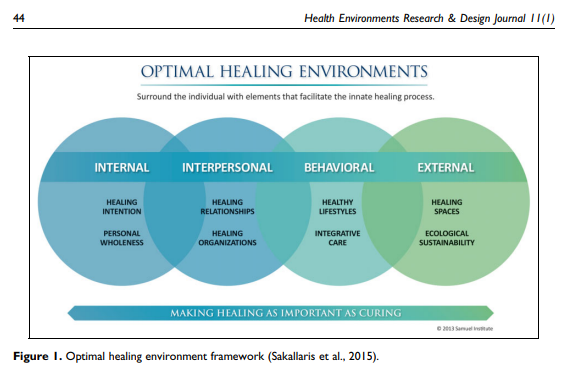
Figure 2. Optimal Healing Environments (duBose, MacAllister, Hadi, & Sakallaris, 2018)
I believe the OHE framework can be applied to spiritual care settings because it asserts that healing spaces that evoke a sense of cohesion of the mind, body, and spirit support healing intention and foster healing relationships (duBose, MacAllister, Hadi, & Sakallaris, 2018).

Figure 2. Optimal Healing Environments (duBose, MacAllister, Hadi, & Sakallaris, 2018)
Herman (1992) poignantly captures the lack of public and/or physical space for trauma survivors. “The most common trauma of women remains confined to the sphere of private life, without formal recognition or restitution from the community. There is no public monument for rape survivors.”
And yet, space and place are crucial for healing. Hemphill (2024, p.xi) says that our stories need airing out and places to land. In fact, this concept is so crucial to their thesis in “What it takes to heal,” that it’s on the first page of the prologue: “There’s something revolutionary about creating a space for people to lay down what burdens them.” Put differently, healing and places intertwine (Sternberg, 2009).
Why then are memorials, monuments, even rituals, reserved for death when the data show that every single person experiences something traumatic at some point in their lives? In order to come to a place of understanding—or healing—one must inhabit the uninhabitable distance between ourselves and our loss events (Bonder, 2009). That is what artistic and architectural practices can do when creating healing spaces. This phrase—inhabit the uninhabitable—has captured my imagination since I first read it. This idea is not unlike Rambo’s (2010) theory of the middle space found in Holy Saturday.
These spaces can act as memorials, as monuments. The word memorial comes from the Latin monere (to advise, admonish, instruct, remind). “A monument is an ancient, one might say archetypal, response to the passage of time: a device to stare out time and extinction. Flesh is made stone. Via the monument, we save that which is temporary by connecting it to—or embodying it in—that which is enduring. A monument is an expression in concrete…” (Bonder, 2009). In my view, one can replace “monument” here with any physical healing space. I can’t help but think of Ranier Maria Rilke’s poem “Pushing Through.”
It’s possible I am pushing through solid rock
in flintlike layers, as the ore lies, alone;
I am such a long way in I see no way through,
and no space: everything is close to my face,
and everything close to my face is stone.
Maybe through inhabiting the uninhabitable, by embodying our grief through place-making and meaning-making, we can keep—but finally remove the stone from its suffocating closeness. Flesh is made stone.
While there isn’t one singular theology of trauma, spiritual care providers must become acquainted with the many theories and approaches to find their own way forward in an age of trauma and spiritual and cultural harm. For my spiritual direction practice, that looks like a theology of trauma and grief that “inhabits the uninhabitable”: claiming sacred space, embracing a fullness of experience embodied in biblical lament, and utilizing contemplative practices for holy reimagination.
___________________________________________
Sources
Baldwin, J. (2018). Trauma-sensitive theology: thinking theologically in the era of trauma. Cascade Books.
Bly, R. (1981). Selected Poems of Rainer Maria Rilke. Harper and Row.
Bonder, J. (2009). On memory, trauma, public space, monuments, and memorials. Places: Forum of Design for the Public Realm, 21(1), 62–69. Retrieved from https://placesjournal.org/assets/legacy/pdfs/on-memory-trauma-public-space-monuments-and-memorials.pdf
Clapp JD, Sowers AF, Freng SA, Elmi LM, Kaya RA and Bachtel AR (2023) Public beliefs about trauma and its consequences: Profiles and correlates of stigma. Front. Psychol. 13:992574. doi: 10.3389/fpsyg.2022.992574
Davis, Ellen F. (2001). Getting Involved with God: Rediscovering the Old Testament, Cowley Publications. ProQuest Ebook Central, http://ebookcentral.proquest.com/lib/duke/detail.action?docID=1022293
DuBose, J. R., MacAllister, L., Hadi, K., & Sakallaris, B. (2018). Exploring the concept of healing spaces. HERD: Health Environments Research & Design Journal, 11(1), 43–56. https://doi.org/10.1177/1937586716680567
Field Guide for Sorrow. (April 2023). Retrieved July 11, 2025 from https://katiekoranda.substack.com/p/and-what-if-you-should-find-yourself
Hansen, D.T. (2024). Trauma-informed spiritual care: interventions for safety, meaning, reconnection, and justice. Fortress Press.
Hemphill, P. (2024). What it takes to heal: how transforming ourselves can change the world. Random House.
Herman, J. (1992). Trauma and recovery. Basic Books.
Juniper House Spiritual Direction. (n.d.). What is spiritual direction? Retrieved July 11, 2025 from https://www.juniperhousetwincities.com/whatisspiritualdirection
Lehne, R. A., & Rosenthal, L. D. (2023). Pharmacodynamics. In *StatPearls*. StatPearls Publishing. https://www.ncbi.nlm.nih.gov/books/NBK507885/
Merriam-Webster. (n.d.). Grief. In Merriam-Webster.com dictionary. Retrieved July 11, 2025, from https://www.merriam-webster.com/dictionary/grief
National Center for PTSD. (March 26, 2025). Retrieved July 11, 2025, from https://www.ptsd.va.gov/understand/common/common_adults.asp#:~:text=Most%20people%20who%20go%20through,Common%20Is%20PTSD%20in%20Veterans
New International Version Bible. (2011). Biblica, Inc.
https://www.biblegateway.com/
Rambo, S. L. (2010). Spirit and trauma: A theology of remaining. Westminster John Knox Press.
Rohr, R. (2025). The tears of things: prophetic wisdom for the age of outrage. Convergent Books.
Sternberg, E.M., (2009). Healing spaces: the science of place and well-being. The Belknap Press of Harvard University Press.
Weiser, J. (1999). Phototherapy Techniques: Exploring the Secrets of Personal Snapshots and Family Albums. PhotoTherapy Centre Press.